
Best Hair Transplant in India: A Patient's Guide Before You Book
August 20, 2026
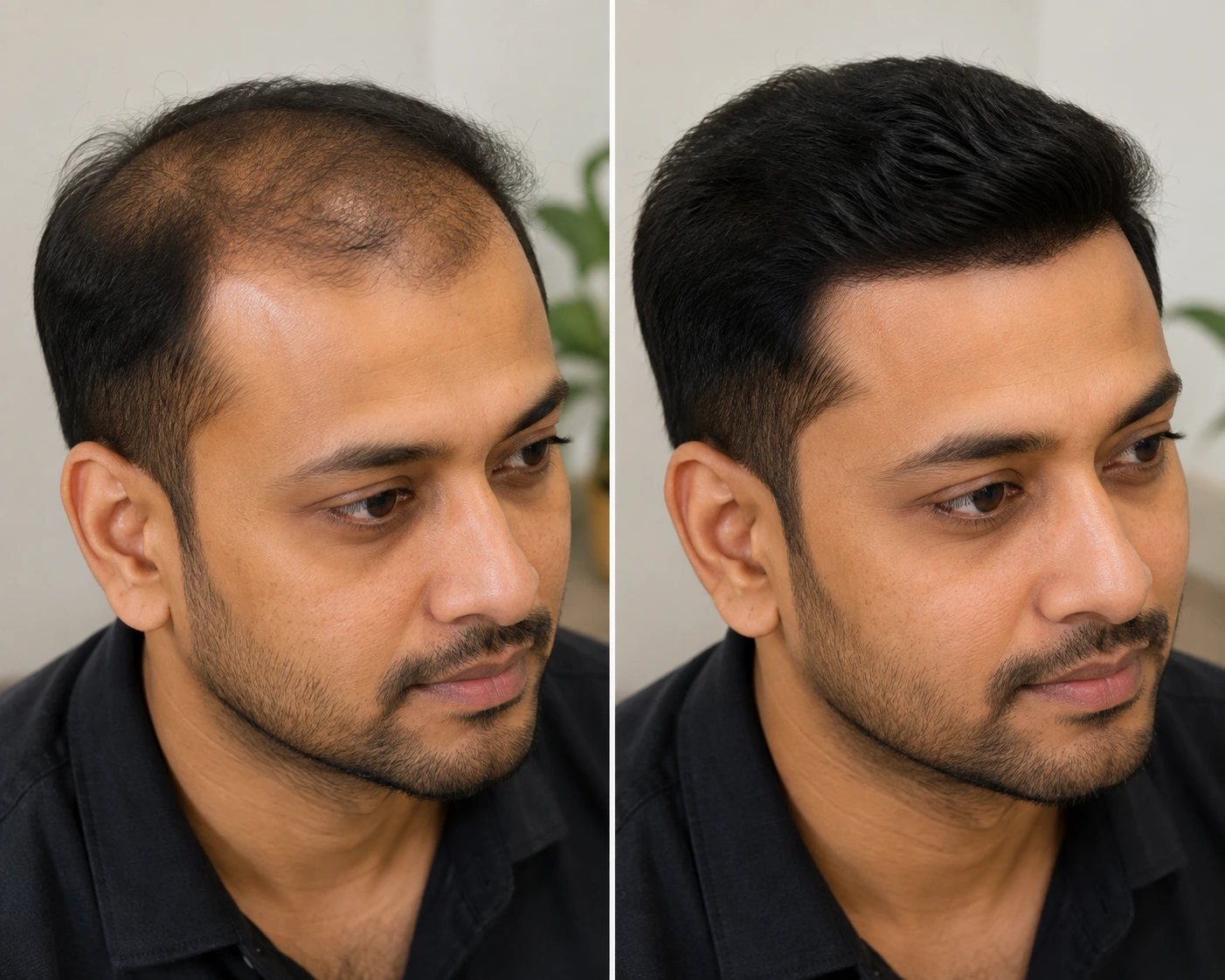
Best Hair Transplant in India: A Patient's Guide Before You Book
It usually starts quietly. A little more hair in the shower drain than you remember. A hairline that looks slightly different in photos than it does in the mirror. A parting that seems wider than it used to be. For most people, this goes on for months, sometimes years, before they actually search for anything — there's a strange reluctance to admit that something as ordinary as hair loss is bothering you as much as it is.
By the time someone starts researching the best hair transplant in India, they've usually already tried a few things — a shampoo that promised thickness, a supplement a friend swore by, maybe a topical solution from the pharmacy. That's a completely normal way to arrive here. Hair loss is common, well understood medically, and in most cases, very treatable once you understand what's actually causing it.
This guide is meant to walk you through that understanding calmly — what causes hair loss, how modern hair transplantation actually works, what recovery and results realistically look like, and most importantly, how to evaluate a surgeon properly before you commit to anything as permanent as a transplant.
Understanding the Need for a Hair Transplant
Hair loss has several possible causes, and not all of them call for surgery. The most common by far is androgenetic alopecia — pattern hair loss driven by genetics and hormones, which affects a large proportion of men and a meaningful number of women over time. Other causes include stress-related shedding, nutritional deficiencies, thyroid or hormonal imbalances, and certain medications, all of which can look similar on the surface but need very different treatment approaches.
The signs worth paying attention to are a gradually receding hairline, thinning at the crown, a widening centre parting, or increased shedding that doesn't settle after a few months. None of these are urgent in a medical emergency sense, but they are worth discussing with a specialist sooner rather than later, because early intervention generally gives more options — medical therapy alone is often enough in early stages, while more advanced thinning may need a combination approach.
This is really the first thing a good consultation should establish: whether what you're experiencing is even a transplant candidate case, or whether it needs to be addressed medically first. A responsible surgeon will tell you this honestly, even if it means you don't need surgery yet.
What Makes Hair Transplantation Effective and Trusted?
A hair transplant works on a fairly simple biological principle: hair follicles taken from a donor area (usually the back and sides of the scalp, which are genetically resistant to pattern baldness) are relocated to thinning or balding areas, where they continue to grow naturally for the rest of a person's life in most cases.
The procedure has been performed and refined for several decades, with substantial published clinical evidence behind current techniques. Two methods dominate modern practice:
- FUE (Follicular Unit Extraction) — individual follicles are extracted one at a time using a small punch tool, leaving tiny, virtually undetectable marks rather than a linear scar. This is the more commonly preferred technique today for its minimally invasive nature and faster recovery.
- FUT (Follicular Unit Transplantation) — a strip of scalp is removed from the donor area and dissected into individual follicular units under microscope. This can allow a higher graft yield in a single session for extensive baldness, at the cost of a linear donor scar.
Both are considered reliable, evidence-based options today, and the right one depends on the extent of hair loss, donor hair availability, and personal preference regarding scarring and downtime. Based on clinical evidence and long-term follow-up data, most patients experience natural-looking, permanent regrowth in the transplanted area — though it's worth being honest that "most patients" is not "every patient," and outcomes depend on donor hair quality, technique, and individual healing.
Why Patients Prefer to Research and Book a Hair Transplant Online
Choosing where to have a permanent procedure done used to depend heavily on word of mouth. That's changed considerably, and mostly for the better. Patients today are able to:
- Research a surgeon's specific training in hair restoration, not just general qualifications
- Look through verified hair transplant before and after galleries from the same clinic
- Book an initial teleconsultation to discuss candidacy before any in-person commitment
- Compare techniques, pricing structures, and graft-count estimates across clinics
- Read genuine patient reviews and testimonials
- Get a second opinion from a specialist outside their own city without travelling first
This access is genuinely valuable, but it also raises the bar on doing the research properly — a large Instagram following or dramatic before-and-after photos aren't the same thing as verified surgical training. The next sections are about separating the two.
Where to Find a Trustworthy Hair Transplantation Clinic
Search rankings and advertising spend don't indicate clinical quality. A few sources are genuinely worth relying on when evaluating a hair transplantation clinic:
- The clinic's own website, particularly the surgeon's credentials and training page, not just the results gallery
- NABH-accredited facilities, which meet defined infrastructure and safety standards
- The National Medical Commission (NMC) or state medical council register, to confirm the treating doctor's registration
- Specialty association listings, such as the Association of Hair Restoration Surgeons of India, for verified members
- A referral from your dermatologist or primary care doctor, who has no commercial stake in a particular hair clinic
Verified platforms are a reasonable starting point for names, but they're not a substitute for checking a specific surgeon's actual hands-on experience with hair transplantation.
How to Choose the Right Doctor for the Best Hair Transplant in India
This is the section that matters most, because the surgeon — not the marketing, not the clinic decor — determines your outcome.
Qualifications
Hair transplantation isn't a formally separate super-specialty in India, so it's especially important to check who is actually performing the procedure. Look for a surgeon with a plastic surgery qualification (M.Ch or DNB) or dermatology background, combined with dedicated, focused training in hair restoration specifically — not just a general cosmetic practitioner who added it to a service list.
Specific experience with hair restoration
Ask directly how many hair transplant procedures the surgeon has personally performed, and whether they have had focused mentorship or fellowship training under a recognised hair restoration specialist. Technique matters enormously here — graft survival and natural-looking density depend heavily on the surgeon's hands-on skill, not just the equipment used.
Hospital affiliation and infrastructure
Even as a day-care procedure, the facility should have proper sterilisation protocols, trained support staff, and a plan for managing any unexpected complication.
Peer recognition and continued learning
Ongoing training, mentorship under established specialists, and active involvement in the surgical community are reasonable signals that a surgeon takes the procedure seriously as a specialised skill rather than a volume business.
Communication style
A good hair transplant consultation should include an honest hairline design discussion, a realistic estimate of graft count and coverage, and a clear answer to "am I actually a good candidate for this." If a surgeon avoids these questions or pushes you toward booking immediately, that's worth noticing.
Second opinions
Because this is a permanent, visible procedure, a second opinion is genuinely wise, not a sign of distrust. An experienced surgeon will understand that and won't be put off by it.
Different Types of Hair Transplant Procedures
Not every case needs the same approach, and understanding the options helps you ask better questions at consultation.
FUE tends to suit patients who want minimal scarring, a shorter recovery, and are comfortable with a slightly longer procedure time for larger sessions.
FUT may be preferred for patients needing a higher graft count in a single sitting, where a linear donor scar (easily hidden by surrounding hair) is an acceptable trade-off.
Day-care procedures are standard for hair transplantation — patients go home the same day under local anaesthesia. Inpatient stays are rarely needed.
In-person consultation is necessary before finalising a treatment plan, since donor density and scalp laxity need to be examined directly. A teleconsultation is a useful first step to discuss general candidacy, technique options, and rough expectations before travelling in.
PRP therapy (platelet-rich plasma) is sometimes used alongside a transplant, or on its own in earlier-stage hair thinning, to support scalp health — this is a separate, non-surgical option worth discussing if your hair loss is still in an early stage.
When Should You Consider Booking a Hair Transplant Consultation?
There's no emergency urgency with hair loss, but there are reasonable signals it's worth having the conversation sooner:
- A receding hairline or thinning crown that has been progressing steadily over 12 months or more
- A strong family history of pattern baldness, which often predicts a similar pattern in you
- Non-surgical options (topical treatments, PRP) tried without meaningful improvement
- A situation where you're simply unsure whether you're even a transplant candidate yet
- Wanting an honest second opinion before committing to a procedure elsewhere
Acting early, even if the answer at that stage is "let's monitor this and try medical therapy first," generally preserves more options than waiting.
What to Expect: Before, During, and After a Hair Transplant
Before. Your consultation will involve an examination of your scalp, donor area density, and hair loss pattern, along with a discussion of your medical history and any medications. Some clinics use scalp imaging to assess density more precisely. You'll receive clear pre-procedure instructions, typically around avoiding certain medications and alcohol in the days beforehand.
During. Most hair transplant sessions take between four and eight hours depending on the number of grafts, performed under local anaesthesia with the patient awake and comfortable throughout. You can generally listen to music, watch something, or simply rest during the procedure.
After. Mild swelling and scabbing in the transplanted area is normal for the first week to ten days. Transplanted hair typically sheds within two to four weeks — this is an expected, normal part of the process, not hair loss failure — before new growth begins around three to four months later.
Risks, honestly. As with any procedure, hair transplantation carries some risk, including temporary swelling, scalp numbness, folliculitis (small bumps around new hair growth), or, less commonly, patchy graft survival. These are discussed openly at consultation rather than glossed over.
Realistic outcomes. Full, final results are typically visible around 10 to 12 months after the procedure, once transplanted hair has grown through its natural cycle. Based on clinical evidence, most patients see good density improvement in the treated area, though final density depends on donor hair quality and the extent of the original hair loss — no ethical surgeon can guarantee a specific outcome before examining you.
Hair Transplant Side Effects and How They're Managed
Being upfront about hair transplant side effects is part of proper informed consent, not a reason for alarm. Most side effects are temporary: mild swelling of the forehead or around the eyes for a few days, scalp tenderness, temporary numbness in the donor or recipient area, and small scabs around each graft that resolve within one to two weeks. Shock loss — temporary shedding of existing hair near the transplant site — can also occur and typically regrows. Less common risks include infection or unsatisfactory graft survival, both of which are minimised with proper technique and aftercare, and are discussed individually based on your health history.
Tips Before You Book a Hair Transplant Online
- Verify the surgeon's registration with the NMC or your state medical council
- Check whether the facility is NABH-accredited or has equivalent safety standards
- Ask specifically about the surgeon's personal experience and case volume with hair transplantation
- Request to see genuine hair transplant before and after results from that surgeon's own patients
- Get a clear, itemised cost estimate, including per-graft pricing and what's included in follow-up care
- Ask about the aftercare protocol and how complications, if any, would be handled
- Get a second opinion if you have any doubts about candidacy or technique
Common Mistakes Patients Should Avoid
- Choosing based on the lowest per-graft price. Unusually cheap pricing is sometimes a sign of rushed, high-volume sessions with lower graft survival.
- Delaying consultation while hair loss progresses. Waiting doesn't cost you money, but it can reduce your options later.
- Relying on unverified before-and-after photos without confirming they're from the actual treating surgeon.
- Overlooking the surgeon's specific hair restoration training in favour of general marketing claims.
- Not disclosing full medical history, including medications and any scalp conditions.
- Skipping post-procedure follow-ups, which are how healing and graft survival are properly monitored.
- Choosing a facility without checking basic safety infrastructure, even for a day-care procedure.
Why Booking a Hair Transplant with a Trusted Specialist Is a Smart Decision
Because this procedure is visible, permanent, and personal, the decision of who performs it matters more than almost any other factor. What consistently makes the difference is dedicated, hands-on training in hair restoration specifically; a facility with genuine safety infrastructure; a structured aftercare plan rather than a one-time appointment; and transparent, itemised pricing without pressure to decide on the spot.
At our practice in Visakhapatnam, Dr. Bhavya Sree brings formal M.Ch training in Plastic Surgery from NIMS, Hyderabad, an international aesthetic fellowship from Ghent, Belgium, and focused mentor-led training in Hair Restoration and Transplant Surgery under Dr. Ashutosh Shah, one of India's recognised specialists in the field. Both FUE and FUT techniques are offered, with the approach for each patient decided only after an honest evaluation of donor hair, hair loss pattern, and realistic candidacy.
If you've been researching the best hair transplant in India and want a conversation that's honest about whether you're even ready for one, that's exactly what a consultation here provides.
Bringing It Back to You
Looking into the best hair transplant in India usually starts with a simple question: is this actually worth doing, and who should do it? Both questions deserve a real answer, not a sales pitch. Qualifications matter. Specific hands-on experience with hair restoration matters. An honest conversation about your donor hair, your hair loss pattern, and what's realistically achievable matters more than any dramatic transformation photo.
If hair loss has been bothering you for a while, it's completely reasonable to want clarity, and equally reasonable to take your time deciding what, if anything, to do about it. A good specialist won't pressure you — they'll examine you, explain your options honestly, and let you decide when you're ready.
If you're comparing your options for the best hair transplant in India and want that conversation with someone local and unhurried, you're welcome to book a consultation, with no obligation to proceed afterward.
Ready for a confidential consultation?
All consultations are private, unhurried, and judgement-free.
Call +91 98516 51234 | Message on WhatsApp | Book a Consultation
This article is for informational purposes only and is not a substitute for professional medical advice. Please consult a qualified doctor for a diagnosis and treatment plan specific to your condition.
Frequently Asked Questions
Is a hair transplant safe? What are the risks?
Hair transplantation is a well-established, extensively performed procedure with a strong safety record when done by a qualified, experienced surgeon at a properly equipped facility. Temporary side effects such as swelling, scalp numbness, and scabbing are common and resolve on their own; less common risks like infection or uneven graft survival are discussed individually before the procedure.
How long is the recovery period after a hair transplant?
Most patients return to normal daily activities within a week, with scabbing resolving in about ten days. Transplanted hair sheds temporarily within two to four weeks before new growth begins around three to four months later, with full results typically visible at 10 to 12 months.
How much does a hair transplant cost in India?
Cost is usually calculated per graft and depends on the technique (FUE or FUT), the number of grafts needed, and the extent of hair loss. An accurate estimate is only possible after a clinical examination of your donor hair and scalp.
Does insurance cover hair transplant surgery?
Hair transplantation is generally considered a cosmetic procedure and is not covered by standard health insurance in India, except in rare cases involving hair loss from injury or a documented medical condition. EMI or financing options are often available for self-paying patients.
Is a hair transplant painful?
The procedure is performed under local anaesthesia, so it isn't painful during the session itself. Mild discomfort, tightness, or tenderness in the days afterward is normal and manageable with routine pain relief.
How do I choose the right doctor for a hair transplant?
Look for a surgeon with dedicated, hands-on training in hair restoration specifically, verifiable case experience, proper facility accreditation, and a willingness to give you an honest, unhurried assessment of your candidacy. A surgeon who welcomes a second opinion is a good sign.
Can I get a second opinion online before deciding?
Yes, a teleconsultation is a reasonable way to discuss your hair loss pattern and general candidacy with a specialist before committing to an in-person visit or a procedure elsewhere.
How soon should I book a consultation if I'm noticing hair thinning?
There's no need to rush into surgery, but earlier consultation generally means more treatment options, including non-surgical ones. Booking a consultation is simply information-gathering and doesn't commit you to any procedure.