Facial Fat Grafting in Visakhapatnam | Dr. Bhavya Sree
September 30, 2026
Facial Fat Grafting: What Patients Should Know Before Booking a Consultation in Visakhapatnam
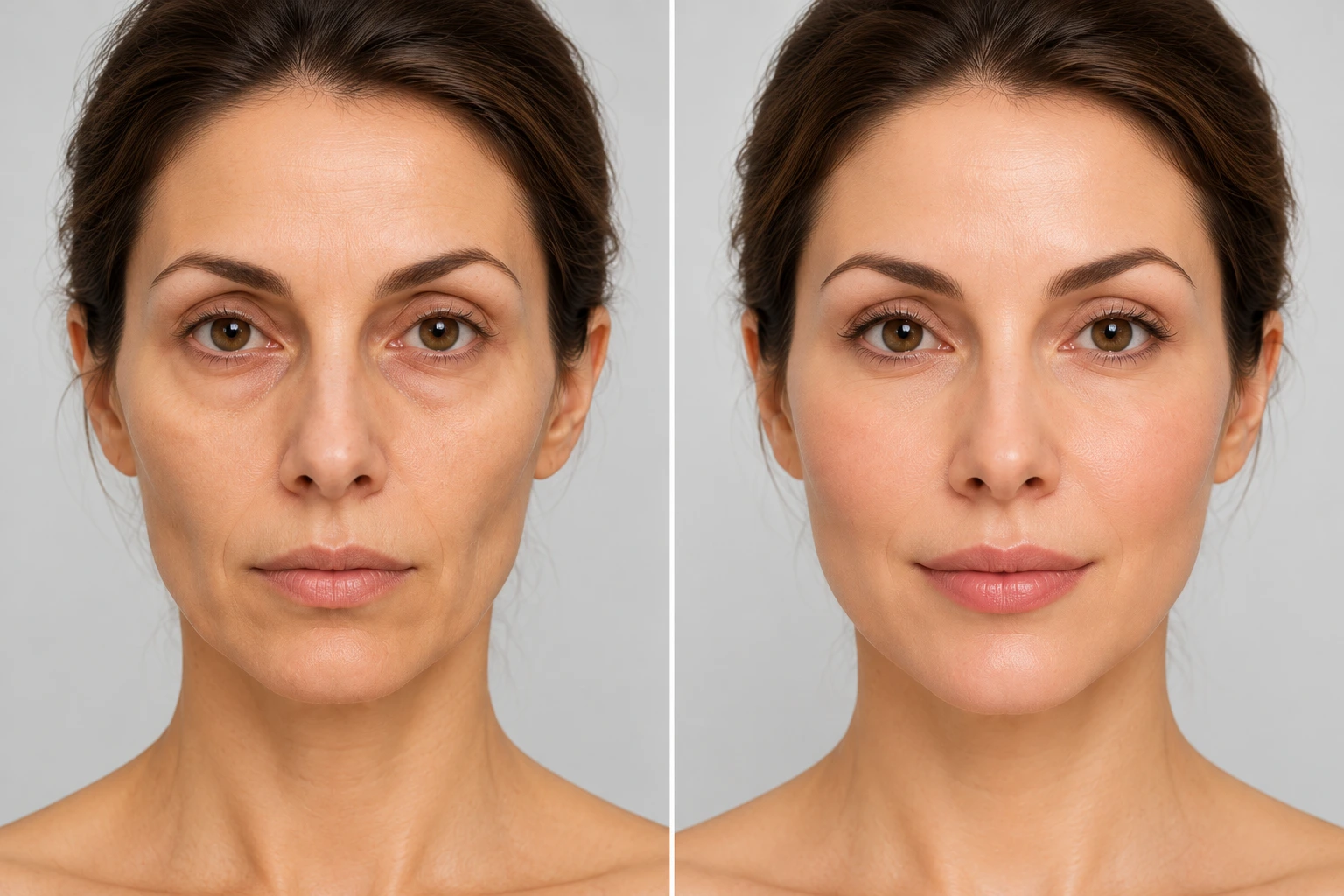
You notice it first in photographs. Not wrinkles exactly, but a tiredness that wasn't there before. The cheeks look flatter. There is a hollow under the eyes that concealer can't quite fill. Friends ask whether you've been sleeping well, and you have.
Many of the people who come to see me describe something like this. Some have lost weight and found their face lost more than they wanted it to. Others have a scar, an old injury, or an asymmetry they have lived with for years. Almost all of them have already spent hours reading online and are unsure what is realistic.
Fat grafting is one of the options they ask about most. In simple terms, it means taking a small amount of your own fat from an area where you have some to spare, purifying it, and placing it carefully where your face has lost volume. It has been refined over several decades and, in experienced hands, is now a well-established, largely day-care procedure.
In this guide, I'll explain who it tends to suit, how it works, what recovery actually feels like, the honest risks, and how to choose the right surgeon, so that you can walk into a consultation feeling informed rather than anxious.
— Dr. Bhavya Sree, Consultant Plastic Surgeon, Visakhapatnam
Understanding Facial Volume Loss and Why People Consider Fat Grafting
A youthful face owes much of its shape to soft fat pads sitting beneath the skin: in the temples, around the eyes, across the cheeks, and along the jaw. Over time, these fat pads gradually shrink and shift downward. The underlying bone also changes slowly. Skin becomes thinner and less elastic.
The result is rarely one dramatic change. It is a collection of small ones that together make a face look tired, sad or older than the person feels.
Common signs people notice
- Hollow temples that make the face look narrow at the top
- Under-eye hollows, often called the tear trough, which cast a dark shadow even after a full night's sleep
- Flattened cheeks that no longer catch the light the way they used to
- Deeper lines running from the nose to the corners of the mouth
- Thinning lips or a less defined jawline
- Depressed scars from acne, injury or previous surgery that sit lower than the surrounding skin
Why it happens
Natural ageing is the most common reason. Other triggers include significant weight loss, intense endurance training, genetics, smoking, sun damage, and certain medical conditions or medications that cause fat loss in the face (a condition called lipoatrophy). In reconstructive practice, we also see contour defects after trauma, burns, tumour removal, and developmental conditions where one side of the face is smaller than the other.
When to see a specialist
For most people, facial volume loss is a quality-of-life concern rather than a medical emergency. It becomes worth a consultation when it genuinely bothers you, affects your confidence, or when makeup and skincare no longer make a difference.
One important exception: if you notice volume loss that is sudden, rapidly progressing, or affecting only one side of the face, please see a doctor promptly. This is uncommon, but it deserves proper medical evaluation before any cosmetic treatment is considered.
Early assessment has a practical benefit, too. Smaller changes can often be addressed with a smaller, simpler treatment, and a proper examination may reveal that you don't need surgery at all.
What Makes Fat Grafting Effective and Trusted?
How the procedure works
Fat transfer to face happens in three stages, all usually completed in a single session:
- Harvesting. A small amount of fat is gently removed, usually from the abdomen, flanks or thighs, using a thin cannula (a narrow, blunt-tipped tube) through tiny incisions. This is a gentle, small-volume form of liposuction.
- Processing. The fat is purified to separate healthy fat cells from fluid, blood and oil. Depending on the area being treated, it may be prepared in different particle sizes.
- Placement. The purified fat is injected in very small amounts, in multiple fine layers, through blunt micro-cannulas. Placing tiny droplets rather than large deposits gives each one the best chance of picking up a blood supply and surviving.
How long it has been performed
Surgeons have been moving fat from one part of the body to another for more than a century. The modern approach took shape in the 1990s, when careful, low-trauma techniques for harvesting and layering fat were described and widely adopted. Since then, a large body of published clinical research has examined how fat tissue behaves once it is transferred.
One refinement is especially relevant here. Nanofat, a finely emulsified form of fat used to improve skin quality rather than add volume, was described by the plastic surgery team in Ghent, Belgium. That is where I completed my aesthetic fellowship, training under Dr. Patrick Tonnard and Dr. Alexis Verpaele. I mention this not as a guarantee of anything, but because it shapes how I plan fat grafting: carefully, conservatively, and in layers.
What the evidence tells us, honestly
Based on clinical evidence, fat that survives the transfer establishes its own blood supply and behaves like living tissue, which is why results may last a long time in suitable patients. However, not every fat cell survives. A portion is naturally absorbed by the body over the first few months, and how much is retained varies from person to person and from one area of the face to another.
This is why many patients see some settling after the initial result, and why some are advised to plan for a second, smaller top-up session.
Why it is considered a reliable option today
- It uses your own tissue, so the concerns that come with synthetic materials, such as reactions to a foreign substance, largely do not apply.
- When done conservatively, the result can look and feel soft and natural, although individual outcomes vary.
- Fat that survives the first few months often behaves like the rest of your natural tissue, ageing along with you.
- It is usually performed as a day-care procedure, often under local anaesthesia with sedation.
- It can be combined with other procedures, such as a facelift or eyelid surgery, where appropriate.
It is not reversible in the way hyaluronic acid fillers are, which is one reason careful planning and an experienced surgeon matter so much.
Why Patients Prefer to Research and Book Online
Most people I meet for facial fat grafting have done a remarkable amount of homework before they call. That's a good thing. Researching online lets you:
- Check credentials in detail, including where your surgeon trained and which professional bodies they belong to
- Look at real facial fat grafting before and after photographs, published with patient consent, to see a surgeon's style
- Read and watch patient experiences on official channels rather than relying on hearsay
- Book a teleconsultation for an initial discussion, especially useful if you live outside Visakhapatnam
- Compare surgeons and hospital affiliations calmly, from home, without pressure
- Schedule appointments and follow-ups at times that suit your work and family
- Seek a second opinion from a specialist in another city if you want reassurance
A short video or phone conversation can help you decide whether an in-person visit is worthwhile. That said, fat grafting always requires a physical examination before a final plan is made.
Where to Find a Qualified Facial Fat Grafting Surgeon
Search results and social media rankings reflect advertising budgets and follower counts as much as surgical skill. Credible sources look a little different:
- Official doctor and hospital websites that clearly list qualifications, registration details and a physical clinic address
- The Indian Medical Register maintained by the National Medical Commission, and your State Medical Council, to confirm registration
- Professional associations such as the Association of Plastic Surgeons of India (APSI) and the Indian Association of Aesthetic Plastic Surgeons (IAAPS)
- Accredited hospitals, for example those accredited by NABH, where surgery is performed with proper emergency backup
- Verified health platforms that display registration numbers and genuine reviews
- Referrals from your family doctor, dermatologist or someone who has had a good experience
If you're looking at facial fat grafting before and after galleries, check that the photos are the surgeon's own patients, taken in consistent lighting, and published with consent. Stock images and heavily filtered photos tell you nothing.
How to Choose the Right Surgeon for Facial Fat Grafting
This is the most important decision you'll make, more important than the technique itself. Here is what I would look for if I were choosing for a member of my own family.
Qualifications
In India, the formal specialist qualification in plastic surgery is an M.Ch or DNB in Plastic Surgery, completed after MBBS and MS in General Surgery. This training covers facial anatomy, fat grafting, reconstruction and the management of complications. Additional fellowships in aesthetic surgery add focused experience.
Relevant experience
Ask specifically how often the surgeon performs facial fat grafting, not just cosmetic surgery in general. The face, and particularly the eyelid region, is unforgiving of excess. Experience teaches restraint.
Hospital and infrastructure
Ask where the procedure is performed, who provides anaesthesia, and what backup exists if something unexpected happens.
Peer involvement and ongoing learning
Membership of professional societies and participation in national and international conferences suggest a surgeon who keeps up with evolving techniques and safety standards.
Communication
A good surgeon explains clearly, discusses risks without being asked, tells you when a procedure isn't right for you, and never pressures you to decide on the day. If you leave a consultation feeling rushed or sold to, trust that feeling.
Second opinions are a good sign
Seeking a second opinion isn't a sign of distrust. Good surgeons welcome it. If a surgeon discourages you from getting one, that tells you something.
About Dr. Bhavya Sree
- M.Ch in Plastic Surgery from Nizam's Institute of Medical Sciences (NIMS), Hyderabad
- Aesthetic surgery fellowship in Ghent, Belgium, under Dr. Patrick Tonnard and Dr. Alexis Verpaele, with training in facial sculpting, MACS facelift and minimal-scar techniques
- 15+ years of surgical experience across aesthetic and reconstructive plastic surgery
- Member of APSI, IAAPS, AHRS-India and BRASA-India
- Regular participant at BRASCON, AESURG, APSICON and ISAPS meetings
Different Types of Facial Fat Grafting
Fat grafting isn't a single fixed procedure. It's tailored to what your face needs. Unlike some operations, it doesn't involve robotic or laser-based surgery; the refinements are in how fat is harvested, processed and placed.
By the type of fat used
- Structural fat (macrofat): larger fat particles used to restore volume in areas with thicker tissue, such as the cheeks, temples, chin and jawline.
- Microfat: finer particles for delicate areas with thin skin, such as the under-eye region and lips, where smoothness matters more than volume.
- Nanofat: fat processed until it no longer adds volume but may help improve skin texture, fine lines and scars. It is often combined with the other two.
Standalone or combined
Fat transfer to face can be done on its own for people whose main concern is volume. For those with loose skin as well, it is often combined with a facelift or eyelid surgery, because volume alone can't lift sagging skin, and lifting alone can't replace lost volume.
Cosmetic or reconstructive
Most facial fat grafting is elective and cosmetic. Reconstructive fat grafting is used for contour defects after trauma or surgery, burn scars, depressed scars, and conditions causing uneven facial development or fat loss. This distinction can affect insurance eligibility.
Anaesthesia and stay
Smaller procedures are commonly done under local anaesthesia with sedation as day-care surgery. More extensive work, or fat grafting combined with other surgery, may be done under general anaesthesia, occasionally with an overnight stay.
Fat grafting or dermal fillers?
| Fat grafting | Hyaluronic acid fillers | |
|---|---|---|
| Material | Your own fat | Manufactured gel |
| Procedure | Minor surgery with fat harvest | Injections in clinic |
| Downtime | Usually 1–2 weeks of visible swelling | Usually a few days |
| How long it lasts | Surviving fat is generally long-lasting | Temporary, typically months |
| Reversible? | Not easily | Yes, can be dissolved |
| Often suits | Larger or multiple areas, those wanting a longer-term result | Small, targeted changes; first-time patients wanting a trial |
Neither is universally better. At our clinic we offer both, so the recommendation depends on your face and goals, not on what we happen to provide.
Consultation formats
You can start with an in-person consultation or a teleconsultation for an initial opinion. Some people come only for advice or a second opinion; others go on to plan treatment. Before deciding, ask what the treatment plan involves, including pre-operative tests and how follow-up visits are arranged.
When Should You Consider Booking a Consultation?
It may be a good time to book a consultation if:
- Hollowness under the eyes or in the cheeks makes you look tired regardless of rest
- You have lost a significant amount of weight and your face looks gaunt compared with your body
- Fillers have worked for you, but you would like to explore a longer-lasting option
- You have a depressed scar or contour defect from acne, injury or previous surgery
- You are planning a facelift or eyelid surgery and want to know whether volume restoration would help
- One side of your face looks noticeably different from the other
A second opinion is wise if you have been advised a large-volume procedure, have had a previous result you are unhappy with, or simply feel unsure about the plan you were given.
Consider a situation many plastic surgeons will recognise. A woman in her forties has tried several creams and a course of fillers for under-eye hollows. The results were pleasant but short-lived, and she is tired of repeating treatments. At consultation, the question is not "fat or filler" but what her specific anatomy needs, and whether her skin, fat pads and eyelids are all contributing. Sometimes the answer is fat grafting; sometimes eyelid surgery; sometimes a combination; and occasionally, a simple reassurance that very little needs to be done.
What to Expect: Before, During and After Fat Grafting
Before surgery
Your consultation includes a careful examination of your face, skin quality, symmetry and possible donor areas. We will discuss your goals, look at photographs, and agree on a plan. You may be asked for blood tests and other routine checks depending on your age and health.
Before surgery, you'll usually be asked to:
- Stop smoking for several weeks, as it reduces blood supply and fat survival
- Tell us about all medicines and supplements, particularly blood thinners and herbal products
- Arrange for someone to take you home and help for the first day
On the day
The procedure usually takes around one to three hours, depending on the number of areas treated. It is performed under local anaesthesia with sedation, or under general anaesthesia, and your anaesthesia team will work to keep you as comfortable as possible. Tiny incisions are made at the donor site and a few discreet entry points on the face. Many patients are able to go home the same day.
Recovery, week by week
- First few days: swelling and bruising are expected and are usually at their peak around days two to three. Discomfort is generally mild to moderate and managed with routine pain relief. Sleeping with your head elevated helps.
- First week: the donor area may feel sore, like a bruise, and a compression garment may be recommended. Avoid pressing, massaging or sleeping on the treated areas unless advised.
- Weeks two to three: most visible swelling settles, and many people feel comfortable returning to work and social activities. Under-eye swelling can take a little longer.
- First three months: some of the transferred fat is naturally absorbed. It's normal for the face to look fuller at first and then settle.
- Three to six months: the final result becomes clear. If a top-up is needed, it is usually planned after this point.
Fat grafting under eyes: a special note
The under-eye area has some of the thinnest skin on the body. Fat grafting under eyes can soften hollows and dark shadows very nicely, but it's also where small irregularities are most visible. Careful technique here means using very fine fat, tiny amounts, deep placement, and a conservative approach. In some people, under-eye hollows are better addressed with eyelid surgery or with fat repositioning, so fat grafting under eyes is one option among several, not the automatic answer.
Risks and possible complications
Every surgical procedure carries some risk. Being open about them is part of good care. With fat grafting, these may include:
- Swelling and bruising, which are expected and temporary
- Partial absorption of fat, which may mean a top-up session is needed
- Small lumps, irregularities or asymmetry, most often in thin-skinned areas
- Over- or under-correction
- Infection, which is uncommon
- Donor site soreness, bruising or minor contour irregularity
- Small oil cysts or firm areas, which are uncommon
- Very rarely, fat entering a blood vessel, which can cause serious problems including vision or neurological complications
That last risk is extremely rare, but it's the main reason facial fat grafting should only be done by a trained surgeon with detailed knowledge of facial anatomy, using blunt cannulas and slow, small-volume injections.
Realistic outcomes
Many patients notice a softer, fresher, more rested appearance. The aim is to look like a well-rested version of yourself rather than a different person, although this cannot be promised in every case. Results vary with skin quality, age, lifestyle and how much fat survives. Fat grafting doesn't stop ageing, tighten loose skin, or correct significant sagging on its own.
Tips Before You Book Fat Grafting
- Verify registration on the NMC Indian Medical Register or your State Medical Council website.
- Check the facility, including accreditation and emergency support.
- Ask about experience with facial fat grafting specifically, and ask to see results in patients with concerns similar to yours.
- Prepare your questions and bring a list of medications, previous treatments (including fillers) and any medical records.
- Understand the full plan, including whether a second, smaller session might be advised later.
- Ask about follow-up: how often you'll be seen, and who to contact if you have a concern after surgery.
- Consider a second opinion if anything feels unclear.
Common Mistakes Patients Should Avoid
- Choosing on offers or convenience alone. Training, experience and safety matter far more. Your face is worth a careful choice.
- Waiting too long when something changes suddenly. Rapid or one-sided facial volume loss should be checked by a doctor.
- Self-diagnosing from photos online. Two people with similar-looking hollows can need completely different treatments.
- Ignoring qualifications. Facial fat grafting is surgery and should be done by a trained plastic surgeon.
- Not sharing your full history. Previous fillers, threads, blood thinners and supplements all affect planning and safety.
- Skipping follow-ups. Early reviews let your surgeon pick up small issues before they become bigger ones.
- Asking for "as much as possible". In the face, too much volume looks unnatural. Subtle is usually better.
- Choosing a setup without emergency backup. Safe surgery depends on the environment as well as the surgeon.
Why Choosing a Trusted Specialist Makes Sense
Fat grafting looks simple from the outside: a little fat, a few injections. In practice, the difference between a natural result and a disappointing one lies in dozens of small judgements about where, how deep and how much. That judgement comes from training and experience.
Choosing a qualified plastic surgeon gives you:
- A plan based on a detailed understanding of facial anatomy
- Honest advice, including when fillers, eyelid surgery or no treatment at all may suit you better
- Proper surgical and anaesthesia safety protocols
- Structured care before and after surgery, with clear follow-up
- Clear information for you and your family at every stage
At our clinic in Visakhapatnam, every consultation starts with listening. I'll examine you, explain what I see, and tell you honestly whether fat grafting is likely to help, and if not, what might.
Does insurance cover it?
Cosmetic fat grafting is generally not covered by health insurance. Reconstructive cases, such as contour defects after trauma, burns or cancer surgery, may be considered depending on your policy, and I can provide clinical documentation where it is appropriate.
Book a Private Consultation
If you'd like to understand whether facial fat grafting is right for you, or you'd like a second opinion on a plan you've already been given, we're happy to help. There's no obligation to go ahead.
- Call: +91 98516 51234
- WhatsApp: Message us
- Online: Book a consultation
- Clinic: Health City, Arilova, Chinagadila, Visakhapatnam, AP 530040
- Hours: Monday to Saturday, 9:00 AM to 4:00 PM
A Final Word on Facial Fat Grafting
Changes in your face can affect how you feel about yourself in ways that are hard to explain to others. Wanting to look as rested and well as you feel is a completely reasonable goal, and it's worth taking seriously.
Fat grafting offers a way to restore lost volume using your own tissue, and for suitable patients the results can look soft and natural. It isn't the right answer for everyone, and it has real limitations and risks. That is exactly why the most valuable step isn't the procedure itself, but a careful, honest assessment by a qualified plastic surgeon.
If something has been bothering you for a while, don't let uncertainty keep you from getting clear answers. Bring your questions, your photographs and your concerns. We'll go through them together, at your pace, so you can make a decision that feels right for you.
Frequently Asked Questions
Is facial fat grafting safe? What are the risks?
When performed by a qualified plastic surgeon in a proper surgical setting, facial fat grafting is a well-established procedure, but like all surgery it carries risks. Common effects include swelling and bruising. Possible complications include partial fat absorption, lumps, asymmetry, infection and, very rarely, serious vascular complications. Your surgeon should discuss these with you in detail before surgery.
How long is the recovery after fat transfer to face?
Most visible swelling and bruising settles within one to two weeks, and many people return to work and social activities around that time. Under-eye swelling may take a little longer. The final result is usually seen at three to six months.
Does insurance cover fat grafting?
Cosmetic fat grafting is usually not covered. Reconstructive procedures, for example after trauma, burns or cancer surgery, may be eligible depending on your policy and documentation.
Is fat grafting under eyes painful?
The procedure is done under anaesthesia to minimise discomfort during it. Afterwards, many people describe mild to moderate soreness, tightness and swelling for a few days, which is usually managed with routine pain relief. The donor site often feels like a bruise.
Are the results of fat grafting permanent?
Some transferred fat is absorbed in the first few months. The fat that survives after that is generally long-lasting, though your face will continue to age naturally. Some people benefit from a second, smaller session.
Can I get a second opinion online?
Yes. A teleconsultation is a good way to discuss your concerns, share photographs and understand your options. A final treatment plan always requires an in-person examination.
This article is for informational purposes only and is not a substitute for professional medical advice. Individual results vary, and no specific outcome can be guaranteed. Please consult a qualified doctor for diagnosis and treatment decisions specific to your condition.