Liposuction Near Me: What to Know Before You Book | Vizag
August 19, 2026
Liposuction Near Me: What to Know Before You Book
There's a particular kind of frustration that brings most people to search for "liposuction near me." It's rarely about a number on a scale. It's the pocket of stubborn fat on the abdomen or flanks that hasn't moved despite months of disciplined eating and regular workouts. It's avoiding certain clothes, certain angles in photos, certain conversations at the gym. For many, it's the quiet realisation that this particular area of the body simply doesn't respond to diet and exercise the way the rest of it does — and that's not a failure of willpower. It's biology.
That search is usually the first honest step someone takes toward doing something about it. And it's a reasonable one. Liposuction is one of the most extensively performed and well-studied procedures in aesthetic surgery, refined over decades to be safer, more precise, and far less disruptive to daily life than it was even ten years ago. Modern techniques mean smaller incisions, more predictable contouring, and recovery timelines that fit around a working life rather than derailing it.
This guide walks through what liposuction actually treats, how the procedure and its variations work, what recovery looks like in real terms, and — most importantly — how to evaluate a surgeon and a clinic properly before you commit to anything. If you're currently comparing options for liposuction near me, this should give you a clearer, calmer picture of what to look for.
Understanding When Fat Removal Surgery Is the Right Conversation to Have
Liposuction is a body contouring procedure, not a weight-loss treatment. That distinction matters, and any honest surgeon will make it clear at your very first visit. It's designed to remove localised, diet-and-exercise-resistant fat deposits — commonly around the abdomen, flanks, thighs, arms, back, or chin — to refine the shape of an area that's otherwise close to the patient's healthy weight.
The patients who tend to benefit most share a few things in common: they're at or near a stable weight, they have reasonably firm skin with some elasticity, and they're dealing with a specific area that hasn't responded to lifestyle changes. Good general health, realistic expectations, and no active smoking are also part of the picture — all of which get assessed properly during a consultation, not guessed at from a photo.
It becomes worth consulting a specialist when the frustration is localised and persistent rather than generalised. If the concern is significant overall excess weight, a surgeon should — and a good one will — have a candid conversation about weight management first, because liposuction isn't designed or intended to replace that. Early, honest conversation with a qualified plastic surgeon avoids wasted time, wasted money, and mismatched expectations later.
What Makes Liposuction Surgery Effective and Trusted?
Liposuction works by breaking down and suctioning fat cells through small, strategically placed incisions using a thin cannula. The fat cells removed from an area are gone from that area permanently — though it's worth being clear that "permanent" refers to those specific cells, not to future weight gain, which can still affect other areas of the body.
The procedure has been performed and refined since the late 1970s, which means it has one of the longer track records in aesthetic surgery, with decades of published clinical evidence behind technique refinement and safety protocols. What has changed significantly is the technology:
- Tumescent liposuction — a fluid solution is infused into the treatment area before fat removal, reducing bleeding, bruising, and post-operative discomfort. This is now the clinical standard.
- Power-assisted liposuction (PAL) — a mechanised cannula that vibrates rapidly, allowing more controlled, less physically taxing fat removal, especially useful in fibrous areas.
- High-definition (VASER / Hi-Def) liposuction — uses ultrasound energy to selectively liquefy fat while sparing surrounding tissue, allowing for more precise contouring and definition, particularly around muscle groups.
Most procedures today are performed as day-care surgery under local anaesthesia with sedation, or occasionally general anaesthesia depending on the treatment area and volume involved. In most cases, patients experience good, natural-looking improvement in body contour — though it's important to say plainly that results vary by individual, by treatment area, and by skin quality, and no ethical surgeon will promise a specific outcome before examining you.
Why Patients Prefer to Research and Book Liposuction Online First
A generation ago, choosing a surgeon meant relying almost entirely on a referral or a name you'd heard once. That's changed, and largely for the better. Patients today can:
- Look up a surgeon's qualifications, training, and registration before ever stepping into a clinic
- Review verified before-and-after galleries and patient testimonials
- Book an initial teleconsultation to ask questions and gauge fit before committing to an in-person visit
- Compare credentials, hospital affiliations, and areas of specialisation across multiple surgeons
- Schedule and reschedule appointments without the back-and-forth of phone tag
- Reach out to a surgeon outside their own city for a second opinion, without needing to travel first
This is genuinely useful — but it also means the research step matters more than ever. A polished website or a large follower count isn't the same as verified training and a real surgical track record. The next two sections are about telling those apart.
Where to Find a Trustworthy Liposuction Clinic
When you're searching for a liposuction clinic, prominence in a search engine is not the same as credibility. A few sources are genuinely worth checking:
- The clinic's own website, specifically the "About" or credentials page — not just the homepage
- NABH-accredited hospitals or day-care facilities, which meet defined standards for patient safety and infrastructure
- The National Medical Commission (NMC) or your state medical council's register, to confirm a doctor's registration is valid
- Specialty association directories, such as the Association of Plastic Surgeons of India (APSI), which list verified members
- A referral from your primary care doctor, who has no incentive to steer you toward a particular cosmetic clinic
Verified platforms and directories are a reasonable starting point for names, but they shouldn't replace your own check of a specific doctor's qualifications and experience with the procedure you're considering.
How to Choose the Right Surgeon for Liposuction Surgery
This is the part worth spending real time on, because the surgeon matters more to your outcome and your safety than almost any other variable in the process.
Qualifications
Look specifically for a plastic surgery qualification — M.Ch (Plastic Surgery) or DNB (Plastic Surgery) in India — not just an MBBS with a certificate from a short cosmetic course. An MS in General Surgery followed by M.Ch in Plastic Surgery indicates a longer, more rigorous surgical training pathway.
Specific experience with liposuction
A surgeon may be broadly qualified but still relatively new to a specific technique. It's entirely reasonable to ask how many liposuction procedures they've personally performed, and whether they have specific training in techniques like high-definition or VASER liposuction if that's what you're considering.
Hospital affiliation and infrastructure
Where is the procedure actually performed? A facility with proper anaesthesia support and emergency backup matters, even for a day-care procedure.
Fellowship or advanced training
Additional focused training — for instance, a dedicated fellowship or mentorship in body contouring or high-definition liposuction under a recognised specialist — is a meaningful signal of ongoing skill development beyond the basic qualification.
Communication style
Does the surgeon explain things clearly? Do they answer your questions directly, or do they rush you toward a decision? A surgeon who takes the time to examine you, discuss your goals, and explain the technique and its limitations honestly is generally a better sign than one who quotes a price before examining you.
Second opinions
If you're uncertain, get a second opinion. A confident, experienced surgeon will not be offended by this — it's a completely normal part of deciding on any surgical procedure, and a good doctor will usually encourage it rather than discourage it.
Different Types of Liposuction Surgery — and Who Each One Suits
Not every case calls for the same approach.
Tumescent liposuction suits most patients seeking moderate fat reduction in a single area, with the advantage of less bleeding and faster initial recovery.
Power-assisted liposuction may be preferred for larger volume areas or more fibrous tissue, such as the back or male chest, where a standard cannula would require more physical effort and time.
High-definition (VASER) liposuction is generally better suited to patients seeking visible muscle definition and contouring — for example, an abdomen with underlying muscle tone the patient wants to reveal, rather than simple volume reduction.
Day-care (outpatient) procedures are standard for most single or dual-area liposuction cases, with the patient going home the same day. Inpatient stays are occasionally recommended for larger multi-area procedures or when combined with another surgery.
In-person consultation remains necessary before any surgical decision, since assessing skin quality, fat distribution, and muscle tone can't be done reliably over video. A teleconsultation is genuinely useful, though, as a first step — to ask general questions, understand a surgeon's approach, and decide whether an in-person visit is worthwhile.
When Should You Consider Booking a Consultation for Liposuction?
There's no medical emergency that liposuction addresses, so there's no need to rush a decision. But there are reasonable signals that it's worth having the conversation:
- A specific area of stubborn fat has stayed unchanged for a year or more despite consistent diet and exercise
- You've reached and maintained a stable, healthy weight but one area still bothers you
- The concern is affecting your confidence or clothing choices in a way that's been consistent, not fleeting
- You're already fit and active and are looking for refined contouring rather than general weight loss
- You want a professional opinion simply to understand whether you're even a suitable candidate
If any of that sounds familiar, a consultation isn't a commitment — it's information. You can walk away from it with nothing more than a clearer understanding of your options.
What to Expect: Before, During, and After Liposuction Surgery
Before. Your first consultation involves a physical examination, a discussion of your goals, and a review of your medical history — including any medications, previous surgeries, and relevant conditions. Basic pre-operative blood work and sometimes an ECG are standard. You'll be given clear instructions on what to stop (certain medications, supplements, smoking) in the weeks before surgery.
During. Most liposuction procedures take between one and three hours depending on the number of areas treated. Local anaesthesia with sedation is common for smaller areas; general anaesthesia may be used for larger or multi-area procedures. Small incisions, usually just a few millimetres, are used to insert the cannula.
After. You'll wear a compression garment for several weeks to support the treated area and reduce swelling — this isn't optional, it's part of how the final contour settles well. Most patients experience swelling and some bruising in the first one to two weeks, gradually improving from there. Mild to moderate soreness is normal in the first few days and is managed with routine pain relief.
Risks, honestly. As with any surgical procedure, liposuction carries risks — including swelling, bruising, temporary numbness, contour irregularity, and, less commonly, infection or fluid accumulation. These are discussed individually at consultation, along with how they're minimised and managed, because an honest conversation about risk is part of informed consent, not a reason to be alarmed.
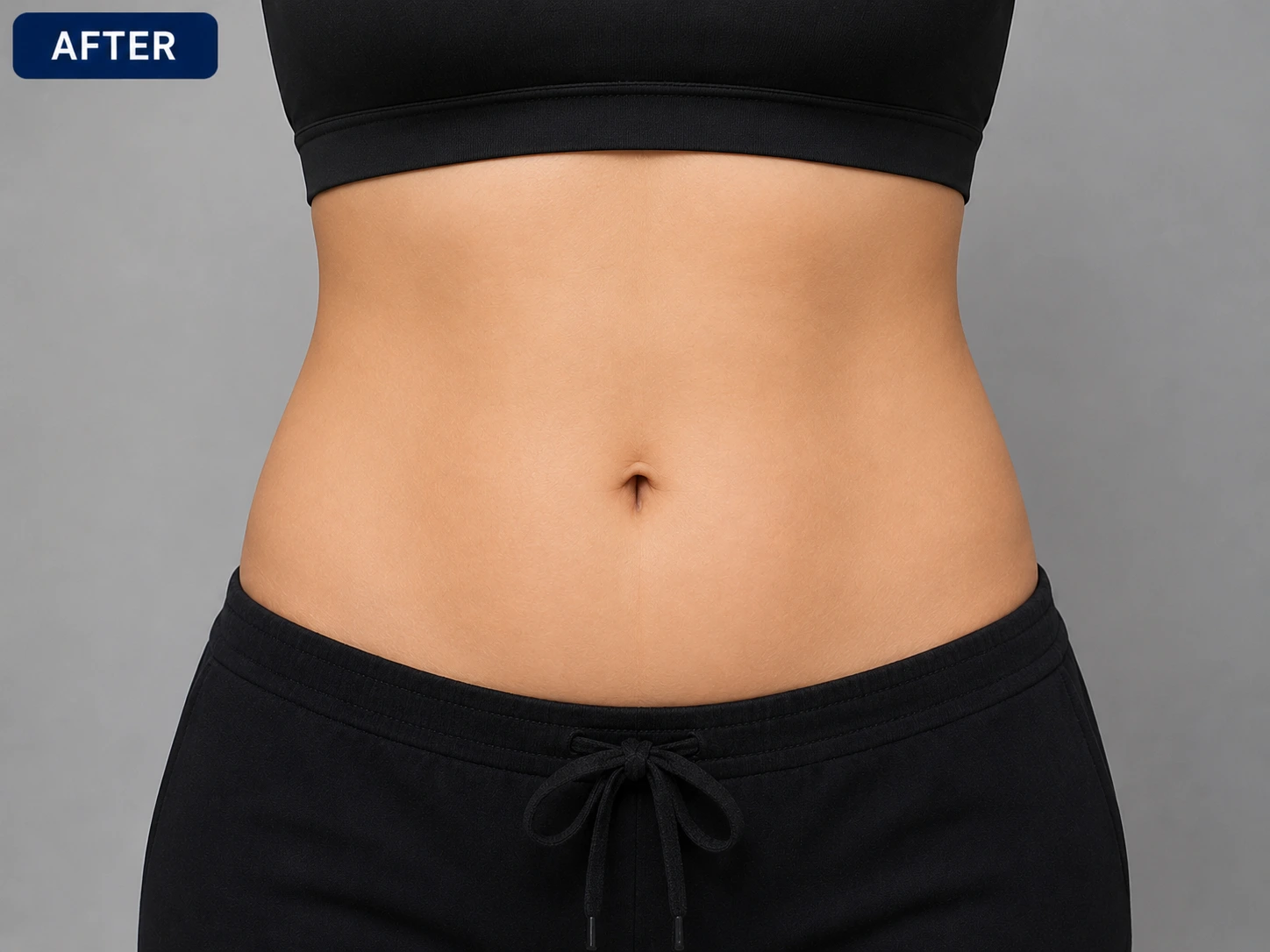
Realistic outcomes. Initial swelling can mask results for several weeks, and the final, settled contour is typically visible around three to six months after surgery. Results are influenced by skin elasticity, the area treated, and how stable your weight remains afterward — none of which any surgeon can promise in advance with certainty.
Liposuction Recovery Time: A Realistic Week-by-Week Picture
Liposuction recovery time varies by the number of areas treated and the technique used, but a general pattern looks like this:
- Days 1–3: Rest, mild to moderate soreness, compression garment worn continuously
- Days 4–7: Most patients return to desk work; swelling and bruising still visible
- Weeks 2–3: Noticeable reduction in swelling; light walking encouraged; still no strenuous exercise
- Weeks 4–6: Gradual return to full exercise, including the treated area, typically after clearance at a follow-up visit
- 3–6 months: Final, settled contour becomes visible as residual swelling fully resolves
This is a general guide, not a guarantee — your own liposuction recovery time depends on the areas treated, your skin quality, and how closely you follow post-operative instructions.
Tips Before You Book Liposuction Surgery Online
- Verify the surgeon's registration with the NMC or your state medical council
- Check whether the facility is NABH-accredited or has equivalent safety infrastructure
- Ask specifically about the surgeon's experience with the technique you're considering
- Bring a written list of questions, along with any relevant medical records, to your first visit
- Get clarity on total costs up front, including anaesthesia, facility fees, and follow-up visits — and ask what's not included
- Ask what post-operative support looks like: how many follow-ups, and what happens if something feels off during recovery
- If you have any doubt at all, get a second opinion before deciding
Common Mistakes Patients Should Avoid
- Choosing based on the lowest price alone. Cost matters, but it shouldn't be the deciding factor for a surgical procedure — the cheapest quote is sometimes cheap because something else has been cut.
- Delaying the consultation indefinitely. You don't need to book surgery, but putting off even a conversation with a specialist often just prolongs uncertainty.
- Relying on unverified information or self-diagnosis. Online forums and influencer content aren't a substitute for an actual clinical examination.
- Overlooking qualifications in favour of marketing. A well-designed website doesn't verify surgical training — check the credentials directly.
- Not disclosing your full medical history. Medications, supplements, and past surgeries all affect surgical planning and safety.
- Skipping follow-up appointments. These aren't a formality; they're how complications are caught early and how your final result is monitored.
- Ignoring the facility's safety infrastructure. Ask what happens if something unexpected occurs during or after the procedure.
Why Booking Liposuction Surgery with a Trusted, Experienced Specialist Matters
When the decision comes down to who you trust with this, a few things consistently make the difference: a surgeon with dedicated plastic surgery training and hands-on experience specifically in body contouring; a facility built for genuine surgical safety rather than just aesthetics; a structured plan for both before and after your surgery, not just the day itself; and honest, transparent pricing without pressure tactics.
At our practice in Visakhapatnam, Dr. Bhavya Sree brings formal M.Ch training in Plastic Surgery from NIMS, Hyderabad, an international aesthetic fellowship from Ghent, Belgium, and focused mentor-led training in high-definition liposuction and body sculpting. With over 15 years of surgical experience and more than 2,000 procedures performed, the approach here is straightforward: an honest assessment of whether you're a good candidate, a clear explanation of the technique best suited to your case, and a transparent, itemised cost estimate — with nothing decided in that first visit except whether you have enough information to make your own choice.
If you've been searching for liposuction near me and want that conversation with someone local, qualified, and unhurried, that's exactly what a consultation here is for.
Bringing It Back to You
Searching for liposuction near me is usually the easy part — the harder part is knowing what to actually look for once the search results appear. Qualifications matter. Specific experience with the technique matters. Honest counselling about what's realistic for your body matters more than any single-photo transformation you'll see online.
If a particular area of your body has stayed stubbornly unchanged despite real effort, it's entirely reasonable to want to understand your options — and equally reasonable to take your time deciding. A good specialist won't pressure you into anything; they'll examine you, answer your questions plainly, and let you decide when, or if, you're ready.
If you're comparing options for liposuction near me in Visakhapatnam, you're welcome to book a consultation, ask every question you have, and walk away with clarity — with or without booking surgery afterward.
Ready for a confidential consultation?
All consultations are private, unhurried, and judgement-free.
Call +91 98516 51234 | Message on WhatsApp | Book a Consultation
This article is for informational purposes only and is not a substitute for professional medical advice. Please consult a qualified plastic surgeon for a diagnosis and treatment plan specific to your body and health history.
Frequently Asked Questions
Is liposuction safe? What are the risks?
Liposuction is a well-established, extensively studied procedure with a strong safety record when performed by a qualified plastic surgeon in an appropriately equipped facility. As with any surgery, risks exist — including swelling, bruising, temporary numbness, and rarely infection or fluid accumulation — and these are discussed individually based on your health and the areas being treated.
How long is the liposuction recovery time?
Most patients return to desk work within a week, resume light activity by weeks two to three, and return to full exercise around weeks four to six. The final, settled body contour is usually visible three to six months after surgery, once residual swelling fully resolves.
How much does liposuction cost, and does insurance cover it?
Cost depends on the number of areas treated, the technique used, and anaesthesia type — an exact figure is only meaningful after a clinical examination. Liposuction performed purely for aesthetic reasons is typically classified as cosmetic and not covered by insurance; EMI or medical financing options are usually available for self-paying patients.
Is liposuction painful?
The procedure itself is performed under anaesthesia, so it isn't painful during surgery. Afterward, most patients report mild to moderate soreness for the first few days, generally well managed with routine pain relief.
How do I choose the right surgeon for liposuction?
Check for formal plastic surgery qualifications (M.Ch or DNB), specific experience performing liposuction, hospital affiliation with proper safety infrastructure, and clear, unhurried communication during your consultation. A surgeon who welcomes a second opinion is generally a good sign.
Can I get a second opinion online before deciding?
Yes — a teleconsultation is a reasonable first step to ask questions and understand a surgeon's approach before booking an in-person visit or committing to surgery.
How soon should I book a consultation if diet and exercise haven't worked on a stubborn area?
There's no urgency in the medical sense, but there's also no benefit to waiting indefinitely if it's affecting your confidence. A consultation is simply information — it doesn't commit you to surgery, and it can help you decide with more clarity, whenever you're ready.