Post Burn Contracture Treatment in Vizag | Dr. Bhavya Sree
October 5, 2026
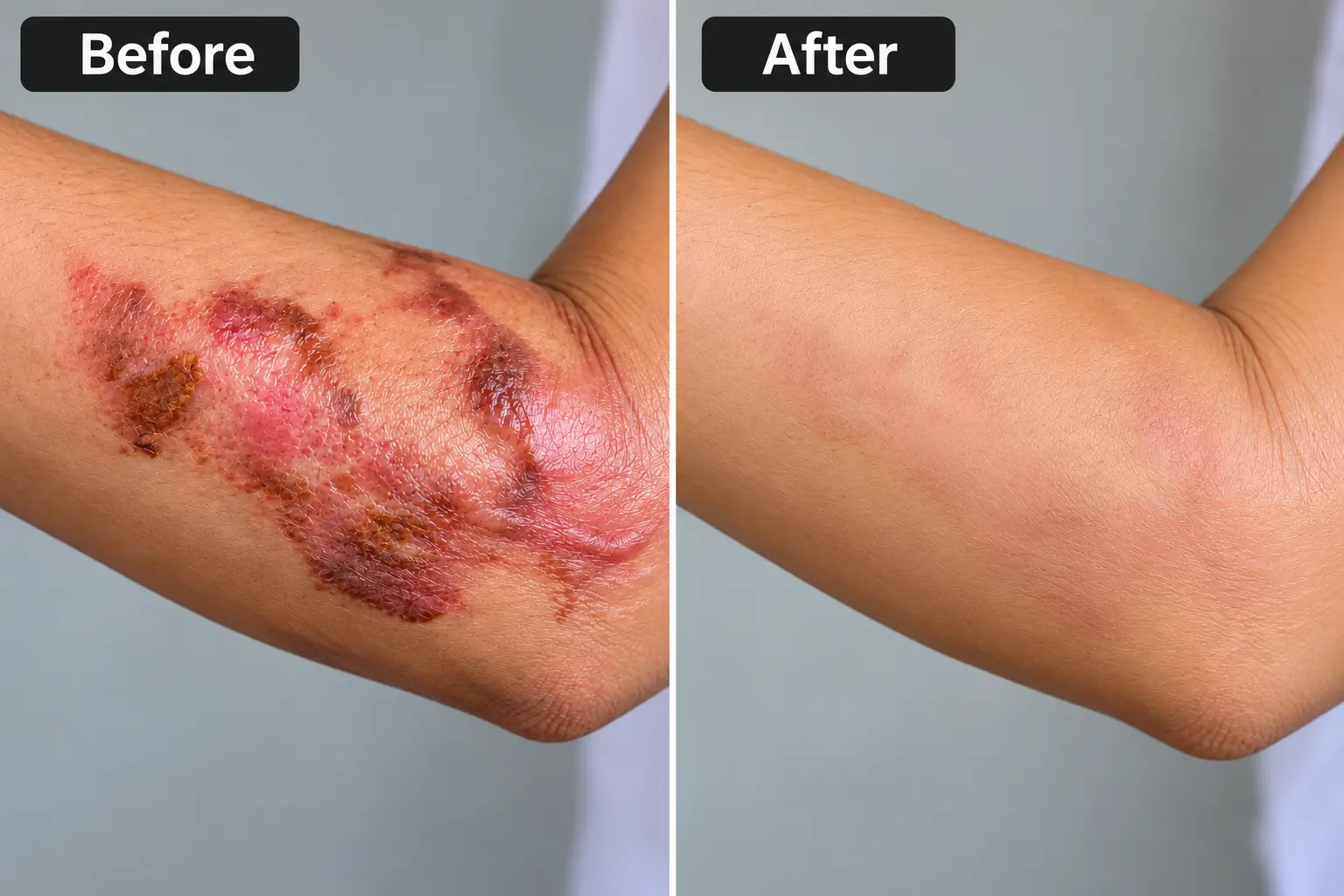
The burn healed months ago. The dressings are gone, the hospital visits have stopped, and everyone around you assumes the hard part is over. But every morning you notice it a little more: your neck won't tilt back fully, your arm won't lift above your shoulder, or your fingers are slowly curling and won't straighten.
This tightening has a name: post burn contracture. It happens when healing scar tissue shrinks and pulls the skin around a joint, limiting how far you can move. It is one of the most common long-term effects of a significant burn, and it can affect how you work, dress, eat, play with your children, or simply look up at the sky.
I want you to know two things early. First, this is not your fault, and it is not something you simply have to live with. Second, post burn contracture is very treatable. Plastic surgeons have been releasing burn contractures for decades, and today's combination of careful surgery, splinting and supervised exercise helps many patients regain movement they thought was gone for good.
In this guide, I'll explain why contractures form, when to seek help, the treatment options from exercise to reconstructive surgery, what recovery really looks like, and how to choose the right surgeon.
Dr. Bhavya Sree, Consultant Plastic Surgeon, Visakhapatnam
What Is a Post Burn Contracture?
When skin is burned deeply, your body repairs it with scar tissue. Scar tissue is a remarkable patch, but it isn't the same as normal skin. It is less elastic, and as it matures over the first several months, it naturally contracts, or shrinks.
On a flat area like the back, that shrinkage may only cause a tight, raised scar. But when the scar crosses a joint, such as the neck, armpit, elbow, wrist, fingers, knee or ankle, it acts like a tight rope pulling the joint into a bent position. That restriction of movement is a contracture.
Who is more likely to develop one?
- Deep burns (deep partial-thickness or full-thickness burns), which destroy the deeper layers of skin and heal with more scarring
- Burns that took a long time to heal, especially those left open for more than two to three weeks
- Burns across joints and skin folds, where the body tends to rest in a bent, comfortable position while healing
- Children, because their bodies keep growing while the scar does not stretch at the same rate
- Patients who couldn't access splinting or physiotherapy during the early healing period, which is very common and not anyone's failure
Common signs to look out for
- A thick, ropy or cord-like band of scar across a joint
- Being unable to fully straighten or bend a joint, such as the elbow, knee or fingers
- The chin being pulled down towards the chest, or difficulty looking up
- Difficulty raising the arm because the armpit skin is tight
- Eyelids that don't close fully, or a mouth opening that has become smaller
- Itching, cracking or recurring wounds along the tight scar
- In children, a limb or posture that seems to be getting worse as they grow
Why early attention matters
A contracture that is left untreated for years can affect more than skin. The tendons, ligaments, nerves and even the joint itself can gradually adapt to the shortened position. In children, a tight scar can influence how bones and joints grow. Early assessment doesn't always mean early surgery; it often means starting the right splints and post burn exercise sooner, which can make any later surgery simpler and more effective.
Contractures from long ago can still be treated. Some of my patients come to me 10, 15 or 20 years after their burn. While earlier is usually easier, it is rarely "too late" to improve movement and comfort.
How Post Burn Contracture Treatment Works
The principle behind treatment is simple: the tight scar does not have enough skin, so we need to release the tension and bring in more skin, or redistribute the skin that is there. How we do that depends on the size, depth and location of your contracture.
Non-surgical treatment
For early, mild or still-maturing scars, the first line of care is usually non-surgical:
- Supervised post burn exercise and stretching to keep the joint moving and gradually lengthen the scar
- Splints, often worn at night, that hold the joint in a stretched position
- Pressure garments that help flatten and soften thick (hypertrophic) scars
- Silicone gel or sheets and regular scar massage
- Steroid injections for small, thick, itchy scar areas
- Fractional CO2 laser, which can soften thick burn scars and improve texture and flexibility in selected patients
Reconstructive surgery for burns
When a firm scar band is clearly restricting movement, reconstructive surgery for burns becomes the most reliable way to restore range. The tight scar is cut or partly removed to release the joint, and the resulting gap is covered using one of these techniques:
- Z-plasty and its variations (multiple Z-plasty, five-flap plasty): the scar is re-arranged into a zig-zag that lengthens the tight line, using your own nearby skin. Ideal for narrow, band-like contractures.
- Skin grafts: a thin layer of healthy skin is taken from another area, usually the thigh, and placed over the released area. Thicker full-thickness grafts are often used for the face and hands because they shrink less.
- Local and regional flaps: healthy skin with its own blood supply is moved from an adjacent area. Flaps tend to be more durable and less likely to re-tighten, which is valuable over major joints like the neck and armpit.
- Free flaps (microsurgery): for very large or complex defects, tissue is transferred from a distant part of the body and its blood vessels are reconnected under a microscope.
- Tissue expansion: a small balloon placed under healthy skin is gradually filled over weeks to grow extra matching skin for reconstruction.
These techniques are supported by decades of clinical evidence and are part of standard plastic surgery training worldwide. What has improved over time is not just the operations themselves, but the planning: choosing the right technique for each body area, staging surgery sensibly, and pairing it with structured therapy afterwards. In most cases, patients experience a meaningful improvement in movement, though the exact result depends on the scar, the joint involved and how consistently rehabilitation is followed.
Why Many Patients Start Their Contracture Care Online
Many burn survivors don't live close to a plastic surgeon. Some have already been told "nothing more can be done." For them, the internet is where the journey to a second chance often begins. Researching and booking online makes sense because you can:
- Check the surgeon's qualifications and training before you travel, including whether they are a qualified plastic surgeon with burn reconstruction experience
- Share photos and old records for an initial opinion through WhatsApp or a teleconsultation, so you know whether an in-person visit is worthwhile
- Watch and read real patient stories, which help you understand what recovery looks like from someone who has lived it
- Compare specialists and hospitals without pressure, at your own pace
- Schedule appointments and follow-ups around work, school or family responsibilities
- Get a second opinion from a specialist in another city, which is often wise before major reconstruction
An online opinion is a helpful first step, but a contracture always needs a hands-on examination before surgery is planned. Movement, scar softness and the condition of the surrounding skin can't be fully judged from a photograph.
Where to Find Trusted Post Burn Reconstruction Treatment in Vizag
If you are looking for post burn reconstruction treatment in Vizag, the good news is that you no longer need to travel to Hyderabad, Chennai or Bangalore for specialist care. When searching, focus on sources that tell you who is actually going to treat you:
- Hospitals with proper surgical infrastructure, ideally accredited by NABH or an equivalent body, with an ICU and blood bank available if needed
- The surgeon's official website, which should list qualifications, training and the procedures they actually perform
- Verified health platforms such as Practo, or the websites of established hospital networks
- The National Medical Commission and the Andhra Pradesh Medical Council registers, where you can confirm a doctor's registration
- The Association of Plastic Surgeons of India (APSI), a professional body for qualified plastic surgeons
- Referrals from your burns unit, general surgeon or family doctor, who often know which local surgeons do this work regularly
A credible source gives you verifiable facts: degrees, registration numbers, hospital affiliations and genuine results. A prominent advertisement on its own tells you very little.
How to Choose the Right Surgeon for Post Burn Contracture
This is the most important decision you will make. Burn reconstruction is very different from cosmetic surgery: it demands knowledge of flaps, grafts, hand anatomy, microsurgery and long-term rehabilitation. Here is what to look for:
Qualifications
Look for a plastic surgeon with an M.Ch or DNB in Plastic Surgery. These are three-year super-specialty programmes after an MS in General Surgery, and burns and reconstruction form a core part of the training.
Specific experience with burns
Ask how often the surgeon treats burn contractures, and in which body areas. Neck, hand and facial contractures each have their own challenges, and regular experience matters clinically.
Infrastructure and team
Good outcomes depend on more than the operation. Check that the hospital has safe anaesthesia, post-operative nursing and access to physiotherapy and splint-making.
Honest communication
A good surgeon explains what can realistically be improved, how many stages may be needed and what your role in recovery will be. Be cautious of anyone who promises a "perfect" or "scar-free" result.
Patient stories and peer recognition
Patient testimonials, conference participation and membership of professional societies indicate a surgeon who stays active in the field.
Second opinions are a good sign, not a sign of distrust. Any confident surgeon will welcome you seeking another view before a major reconstruction. If a doctor discourages it, take note.
About my training in burn reconstruction
My M.Ch training at Nizam's Institute of Medical Sciences (NIMS), Hyderabad covered microsurgery, burns, hand surgery and craniofacial trauma, which are the core skills behind contracture release and reconstruction. I also completed an aesthetic surgery fellowship in Ghent, Belgium, with a focus on minimal-scar techniques and three-dimensional planning, which shapes how I think about the appearance of a reconstruction, not just its function. Over 15+ years of surgical experience, I have treated many burn survivors, and I take part in forums including the Asia Pacific Burn Association as well as national plastic surgery conferences. I'm a member of APSI and IAAPS. You can read more on my profile page.
Different Types of Post Burn Contracture Treatment
Every contracture is different, so treatment is built around you. Here's a simple overview of how plans vary:
| Approach | Typically suited to | What it involves |
|---|---|---|
| Therapy-only plan | Early, mild or still-maturing scars | Post burn exercise, splints, pressure garments, silicone and scar massage |
| Laser and injections | Thick, itchy or raised scars with mild tightness | Fractional CO2 laser sessions and/or steroid injections, often alongside therapy |
| Day-care or short-stay surgery | Small, band-like contractures (e.g. a single finger or elbow band) | Z-plasty or small grafts, sometimes under regional or local anaesthesia |
| Inpatient reconstruction | Larger contractures of the neck, armpit, hand or face | Release with grafts or flaps under general anaesthesia, with a hospital stay of a few days |
| Staged or complex reconstruction | Multiple contractures, large areas, or contractures needing microsurgery or tissue expansion | A planned series of surgeries over months, prioritised by function |
Elective vs. urgent treatment
Most contracture surgery is planned (elective), ideally once the scar has matured, often 6 to 12 months after the burn. Earlier surgery may be advised when a contracture threatens the eyes (eyelids that cannot close), makes eating or speaking difficult, restricts breathing or neck movement significantly, severely limits hand use, or is affecting a child's growth.
Consultation options
You can start with a teleconsultation or WhatsApp photo review for an initial opinion, followed by an in-person examination before any decision about surgery.
When Should You Book a Consultation?
Consider booking an assessment if:
- You can't fully straighten, bend or lift a part of your body that was burned
- The tightness is getting worse, rather than better, despite exercises
- The scar keeps cracking, bleeding, itching intensely or forming wounds
- Daily tasks like dressing, writing, eating, walking or working have become harder
- Your child has a burn scar over a joint, even if they seem to be coping well now
- You've been told nothing more can be done and would like a second opinion
- You've had contracture surgery before and the tightness has returned
One patient in his late thirties came to see me nearly eight years after a kitchen fire. His armpit scar meant he couldn't lift his arm above shoulder height, and he had quietly given up on a job that involved overhead work. After a release with a local flap and four months of disciplined physiotherapy, he was lifting his arm fully again. His biggest regret was that he hadn't come sooner.
Shared anonymously, with details changed to protect privacy. Individual results vary.
What to Expect: Before, During and After Contracture Surgery
Before surgery
At your consultation, I'll examine the scar, measure your range of movement, check the surrounding skin and discuss your daily activities and priorities. If you have several contractures, we'll agree on which to treat first, usually the one most affecting your function. You'll have routine blood tests and an anaesthetic check, and we'll plan your splints and physiotherapy in advance. Please bring your old burn treatment records if you have them.
On the day
Most contracture releases are done under general anaesthesia, though smaller ones may be done under regional or local anaesthesia. Surgery typically takes one to four hours, depending on the area and technique. The joint is released, the new tissue is secured, and a protective dressing and often a splint are applied.
After surgery
- First few days: Rest with the area elevated and kept still so grafts or flaps can settle. Pain is managed with regular medication. If a skin graft was taken, the donor site (often the thigh) is usually the most uncomfortable part.
- Days 5 to 7: The first dressing change, when we check how well the graft or flap has taken. Many patients go home around this time.
- Weeks 2 to 3: Stitches are removed and gentle supervised movement begins once healing allows.
- Weeks 3 to 6: Post burn exercise becomes more active, with splints usually worn at night and pressure garments introduced.
- 3 to 6 months and beyond: Continued stretching, pressure therapy and scar care while the new scar matures. This phase protects your result.
Post burn exercise: your part in the result
Surgery creates the opportunity; exercise keeps it. New scars try to contract again for many months, and regular stretching is what stops that from happening. Your physiotherapist will tailor exercises to the joint treated, but they generally include:
- Range-of-motion exercises, moving the joint gently to its full available range several times a day
- Sustained stretches, holding a comfortable stretch rather than bouncing
- Functional practice, such as gripping, reaching overhead, or looking up, built into daily routine
- Strengthening of muscles that may have weakened during the period of restricted movement
- Positioning, for example avoiding a thick pillow after neck surgery
Please don't start aggressive stretching on fresh grafts or a healing wound without guidance. Done at the wrong time, it can damage the repair.
Risks, explained honestly
Like any surgery, contracture release carries risks. These include infection, bleeding, partial loss of a graft or flap that may need further dressing or a small repeat procedure, wound breakdown, colour or texture differences between grafted and surrounding skin, and recurrence of tightness, especially if splinting and exercises aren't followed. Large or multiple contractures may need more than one operation. I'll discuss the risks that apply to your specific case before you decide anything.
Realistic outcomes
The aim is improved movement, comfort and function, along with a better appearance where possible. Many patients regain a significant part of their lost range; some regain it fully. Burn scars can't be erased entirely, and grafted skin won't look exactly like untouched skin, but scars do continue to soften and fade over 12 to 18 months.
From severe burn to walking again: a patient shares their recovery journey, with consent.
Tips Before You Book Post Burn Contracture Treatment Online
- Verify registration with the National Medical Commission or the Andhra Pradesh Medical Council.
- Confirm the surgeon is a qualified plastic surgeon (M.Ch or DNB) with burn reconstruction experience.
- Check the hospital's facilities, including accreditation such as NABH where available, and emergency support.
- Gather your records: discharge summaries, previous surgery notes and a list of current medicines.
- Take clear photos of the scar with the joint straightened as far as it goes, for a remote opinion.
- Write down your questions, including how many stages may be needed and how long therapy will last.
- Ask about costs and insurance early, including what's included and whether physiotherapy and splints are extra.
- Ask about follow-up: how often you'll be reviewed and who to call if there's a problem.
- Plan your time off work or school, and arrange support at home for the first week or two.
Common Mistakes to Avoid
- Choosing purely on price. A cheaper operation that needs repeating, or one done without proper therapy support, often costs more in the end.
- Waiting for it to "loosen by itself." Mature contractures rarely release without treatment, and long delays can affect the joint.
- Relying on creams and oils alone. Moisturising helps comfort, but it cannot lengthen a contracted scar band.
- Choosing a doctor without plastic surgery training for a complex reconstruction.
- Not disclosing your full medical history, including diabetes, smoking, blood thinners or previous surgeries.
- Stopping exercises, splints or pressure garments too early, which is the most common reason contractures return.
- Skipping follow-up visits, when early adjustments to splints or therapy can make a real difference.
Why Choosing a Trusted Specialist Makes the Difference
Burn reconstruction is a long journey, and the right team makes it far easier to walk. Choosing an experienced plastic surgeon gives you:
- A plan matched to your scar and joint, rather than the same operation for everyone
- The full range of techniques, from Z-plasty to grafts, flaps, laser and microsurgery, so the right tool is chosen, not just the familiar one
- Structured care before and after surgery, including splinting, pressure therapy and physiotherapy guidance
- Clear, written cost estimates and help with the documentation your insurer may need
- Continuity: the same surgeon following you through months of recovery, close to home in Vizag
At our clinic in Health City, Arilova, I see burn survivors of all ages, including people who had their burns many years ago. If you'd like to understand your options, I'd be glad to examine you and talk them through honestly. You can see patient journeys on our YouTube channel and results in our before & after gallery.
From 40% burns to recovery after an industrial accident: a patient's story, shared with consent.
Moving Forward After a Burn
Surviving a burn takes enormous strength. Living with a post burn contracture afterwards can feel like the injury is still holding you back, but it doesn't have to stay that way.
Whether your scar is a few months old or many years old, there are options: supervised post burn exercise and splinting for early scars, laser and scar therapy for thick tissue, and reconstructive surgery for burns when a firm band is limiting your movement. The key is an accurate assessment by a qualified plastic surgeon, a plan built around your daily life, and steady commitment to rehabilitation afterwards.
You don't need to decide anything today. A consultation is simply a chance to understand your scar, your options and what improvement is realistic for you. If post burn contracture is affecting you or someone you love, I'd encourage you to take that first step. Please reach out; we're here to help you move more freely again.
Book a consultation for your burn scar
Share a photo on WhatsApp for an initial opinion, or book an in-person assessment at our clinic in Health City, Arilova, Visakhapatnam. Consultations Monday to Saturday, 9:00 AM to 4:00 PM. Our team responds within 24 hours.
Frequently Asked Questions
Is surgery for post burn contracture safe?
Contracture release is a well-established reconstructive procedure that plastic surgeons have performed for decades. Like any surgery, it carries risks such as infection, partial graft loss, bleeding and recurrence of tightness. A qualified surgeon will explain the risks specific to your case and take steps to minimise them.
How long is the recovery after contracture surgery?
Most patients stay in hospital for a few days. Grafts and flaps are checked around day five to seven, and gentle movement starts once healing allows. Splints, pressure garments and post burn exercise usually continue for three to six months or longer while the new scar matures.
Can a burn contracture improve with exercise alone?
Early or mild contractures often improve with supervised stretching, splinting, pressure garments and scar care. Established contractures with a firm scar band usually need surgical release, and exercise remains essential afterwards to keep the improvement.
How much does post burn contracture surgery cost in Visakhapatnam?
The cost depends on the area involved, the size of the contracture, the technique required (Z-plasty, grafts or flaps), whether more than one stage is needed and the length of hospital stay. After examining you, we provide a complete written estimate so you know exactly what to expect.
Does insurance cover reconstructive surgery for burns?
Because contracture release restores movement and function, it is generally considered reconstructive rather than cosmetic, and many health insurance policies cover it. Coverage depends on your individual policy, so please confirm with your insurer. Our team can provide the clinical documentation they may ask for.
My burn happened many years ago. Is it too late?
Usually not. Contractures that are 10 or 20 years old can still be released and reconstructed. Long-standing cases may need additional therapy afterwards if the joint has also stiffened, and this will be assessed at your consultation.
Is the surgery painful?
You won't feel the surgery itself because it is performed under anaesthesia. Afterwards there is some discomfort, particularly at a skin graft donor site, which is managed with regular pain medication. Most patients find it settles within the first one to two weeks.
This article is for informational purposes only and is not a substitute for professional medical advice. Please consult a qualified doctor for diagnosis and treatment decisions specific to your condition. Patient stories are shared with consent and individual results vary.