
Wound Care & Debridement
Why Choose Dr. Bhavya Sree for Wound Care & Debridement?
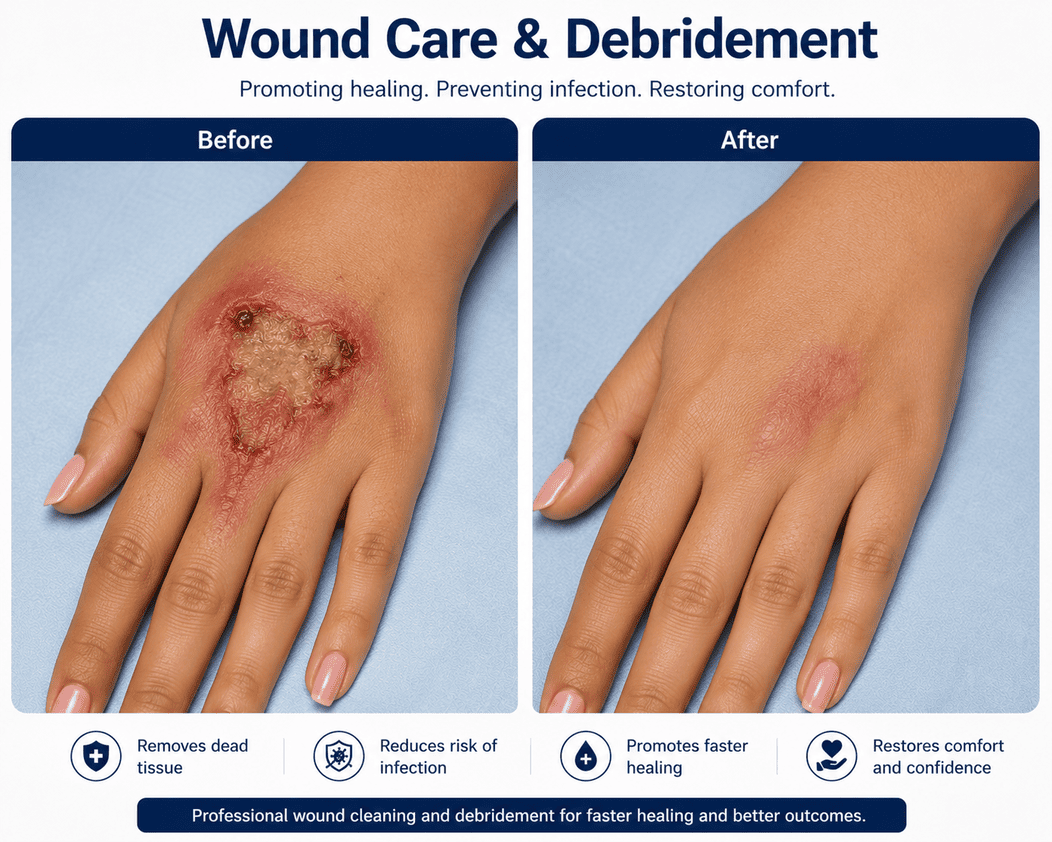
Complex wounds need specialist hands. Expert wound care that heals. Not all wounds close on their own -- and not all wound care is equal. Chronic, infected, traumatic, or post-surgical wounds that fail to heal appropriately require specialist assessment, debridement (removal of dead or infected tissue), and a structured wound management plan.
As a plastic surgeon, Dr. Bhavya Sree brings reconstructive expertise to complex wound management -- not only healing the wound, but planning the optimal closure technique (primary closure, skin graft, or flap) when the wound bed is ready.
A wound that has not healed for 4 weeks or more is classified as a chronic wound and warrants specialist assessment. Do not persist with repeated standard dressings alone -- a structured specialist plan significantly improves healing rates and quality of closure.
M.Ch Plastic Surgery -- NIMS Hyderabad (India's premier surgical training institution) FAM & FAS (Belgium) -- International fellowship-level training in aesthetic and reconstructive surgery All consultations, procedures, and injectables performed personally by Dr. Bhavya Sree -- never delegated Visakhapatnam's only plastic surgeon with dual international fellowship credentials in aesthetic surgery Natural-looking results -- surgical technique guided by an artist's eye for proportion and harmony
Types of Wounds Managed
Chronic non-healing ulcers -- diabetic foot ulcers, venous leg ulcers, pressure sores Post-surgical wound dehiscence -- wounds that have opened after surgery Infected wounds -- requiring debridement and culture-directed antibiotics Traumatic wounds -- complex lacerations, degloving injuries, crush injuries Post-radiation wounds -- radionecrosis and wounds in previously irradiated tissue Necrotising fasciitis -- aggressive soft tissue infections requiring urgent surgical debridement Pilonidal sinus -- chronic natal cleft wounds requiring excision and reconstruction Debridement Methods
Method When Used Surgical Debridement The most definitive method -- all devitalised tissue sharply excised under anaesthesia, leaving a clean wound bed. For complex or large wounds. Sharp Bedside For less extensive wounds. Performed under local anaesthesia. Debridement Negative Pressure Wound Specialised dressing system applying controlled suction -- removes Therapy (NPWT / VAC) exudate, reduces bacterial load, stimulates granulation tissue, and prepares for closure. Enzymatic Debridement Topical agents that chemically break down necrotic tissue. Used for wounds unsuitable for surgical debridement.
The Wound Care Pathway at Dr. Bhavya Sree's Clinic Stage 1: Assessment Full wound evaluation -- size, depth, infection status, blood supply, underlying cause Stage 2: Wound Swab & Bloods Microbiological culture to guide antibiotic therapy; nutritional and vascular assessment Stage 3: Debridement Surgical or sharp removal of all non-viable tissue Stage 4: Wound Bed Advanced dressings, NPWT, infection control -- preparing for Preparation closure Stage 5: Definitive Closure Primary closure, skin graft, or flap -- once wound bed is clean Stage 6: Follow-Up and granulating Structured dressing review and monitoring until fully healed The Role of Nutrition in Wound Healing
Wound healing is metabolically demanding. Patients with poorly healing wounds are frequently nutritionally depleted -- low in protein, zinc, vitamins A and C, and iron. Dr. Bhavya Sree assesses nutritional status as part of every wound care plan, with dietary advice and supplementation prescribed where deficiencies are identified. Optimising nutrition is often the missing link in wounds that have failed to heal despite multiple treatments.
Frequently Asked Questions
My wound has not healed for months despite dressings. Should I see a specialist? Absolutely and urgently. A wound that fails to show meaningful progress within 4 weeks of standard treatment is a chronic wound that requires specialist assessment. Continuing with repeated dressings alone without addressing the underlying cause delays healing and increases the risk of serious complications.
What makes a diabetic foot ulcer so difficult to heal? Diabetic foot ulcers are complicated by three interconnected problems: peripheral neuropathy (loss of protective sensation), peripheral vascular disease (reduced blood supply), and immunological dysfunction (reduced ability to fight infection). Managing a diabetic foot ulcer requires simultaneous attention to all three. Dr. Bhavya Sree works with a multidisciplinary team including vascular surgeons, diabetologists, and podiatrists.
Can all complex wounds be healed? The majority of complex wounds can be healed with appropriate specialist management. In some cases -- particularly where blood supply is severely compromised -- healing may not be achievable without vascular intervention first. Dr. Bhavya Sree will be honest about prognosis and will refer to vascular surgery colleagues when needed.
A wound that won't heal deserves specialist attention. Contact Dr. Bhavya Sree -- drbhavyaplasticsurgery.com
Ready to begin?
Speak directly with Dr. Bhavya Sree — every consultation is personal, confidential, and free of pressure.